The bad process nobody owns
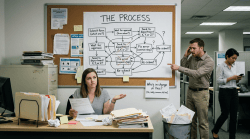
McKinsey’s Brooke Weddle offers a warning to every executive considering an AI program: “You don’t want to tech-enable a bad process.” In a recent interview, she repeats the argument that companies too often add technology before questioning the work it is meant to support. More importantly, she also says that the organizational change after the technology decision takes most of the effort.
I agree with her observations. They mirror research by WorldCC and the CCM Institute. Her example is the finance function, where AI absorbs routine tasks and analysts move to strategic support. That is redesign inside one department. The processes that cost organizations most sit between departments, and they rarely appear on anyone’s redesign list. McKinsey’s own readiness research finds just 11 percent of organizations have reached the stage where they rethink how work gets done and how value is created.
The process nobody owns
Contracting is the clearest case. A single agreement passes through sales or procurement, legal, operations, delivery and finance. It then continues across the boundary to the other party, who runs a parallel chain of its own. Each function sees its own piece and measures its own piece. Nobody owns the whole.
Our research shows how much that matters. Where contract management sits shapes what it pays attention to. In Legal, deal economics and financial impact barely feature. In Finance, the focus narrows and risk is seen in purely financial terms. Each placement optimizes a fragment, and they rarely join up into a view of whether the deal is delivering what it promised.
Why better people and better tools don’t fix it
When results are disappointing, the usual response is to recruit, retrain or reorganize. Increasingly it also involves giving individual functions an AI tool. None of these touches the core problem – fragmented process and fragmented data. It’s not the people, it’s the system.
The cost is huge. WorldCC and CCM Institute research puts average contracted value erosion at around 9%, rising to 11% on the buy side. That loss accumulates in the hand-offs: terms agreed but not communicated, obligations no one tracks, changes that are never priced.
Weddle makes a further point that has been evident in CLM implementations for years. Adoption rates can fall over time, so success has to be measured by sustained value. Users won’t adopt technology unless they see a benefit, and the benefit only arises once the data is joined up. A tool placed on one fragment of a broken process will show early usage and then fade.
Redesigning the whole commitment
Taking Weddle’s advice seriously means applying it to the process that runs from opportunity to outcome, across every function involved and out to the counterparty. Three things follow.
- Integrated data first. A shared view of commitments, obligations and performance allows work to sit wherever the organization chooses. Without it, every function keeps its own version of the truth.
- Integrated roles. Weddle asks whether people have the skills for a different role. In commercial work, the job openings we analyze show that role is already emerging: the Commercial Integrator, who connects the deal to its delivery and its economics. But to succeed, these integrated roles need integrated data.
- Protect the relationship. Weddle notes that some routine tasks, such as checking in with a colleague, build relationships. Automating them can remove something valuable. In contracting the same holds with the other party. Routine contact is often where problems surface early enough to fix and where human relationships result in mutual care.
The real test
McKinsey is right that AI transformation starts with rethinking work. For most organizations, the work most in need of rethinking is the set of commitments they make to customers and suppliers, and the system that is supposed to deliver them. Until that system is redesigned end to end, contracted value will keep leaking away, however good the people and however clever the tools.
Sources
- Brooke Weddle on why AI transformation starts with rethinking work, McKinsey
- AI is changing work. Now it has to change the organization, McKinsey Quarterly, October 2026
- WorldCC and CCM Institute research on value erosion and job-advertisement analysis

