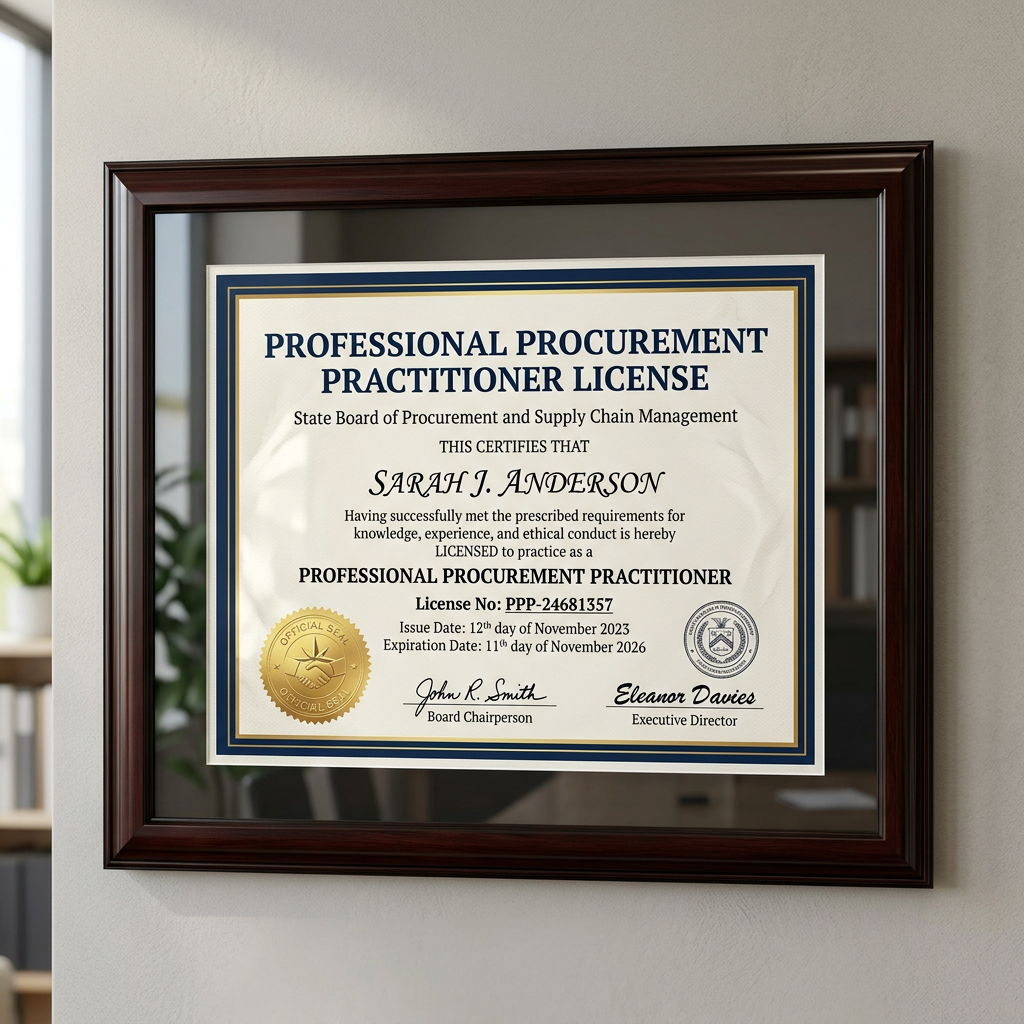
Licensed to do what?
Every business function wants to elevate its role, its influence, its status. So it is in this context that we should consider current conversations about the need for ‘licensed procurement professionals’. It’s an important conversation because it opens the opportunity to discuss our fast changing business environment and how commercial roles more broadly should evolve. And that’s where World Commerce & Contracting naturally tends to show its leadership through research – and that research certainly indicates the importance of upskilling to escape the limits of today’s procurement activities.
So should we embrace the idea of Licensed Procurement Professionals? Let’s set aside the immediate linguistic objection about the desination ‘professional’ – professions are nouns (lawyer, doctor, engineer, actuary) and there is no noun for someone who procures, unless it is ‘buyer’ or ‘procurer’, neither of which has much immediate appeal. But the more important questions are these: licensed to do what? Accountable for what? And to whom?
Licences exist for a reason. Society grants them where unqualified practice causes harm, and in exchange it demands something: a duty that extends beyond the employer. The doctor answers to the patient. The lawyer answers to the court. The engineer answers to public safety. In each case, the licence creates personal accountability for outcomes affecting people who sit outside the employing organization.
So test procurement against that standard. If (as has been suggested) the licence is to be grounded in ethical practice, the profession’s record based on its current practices invites awkward questions. How many suppliers driven into insolvency by imposed terms and stretched payment? How many jobs destroyed in the process? How many disputes generated when buying power was used to walk away from commitments? How many start-ups relieved of their margins, their innovation, sometimes their existence, by customers who knew they had no choice?
These are not fringe behaviors. They are, in many organizations, measured and rewarded. Procurement becomes the vehicle for their implementation and is trained accordingly by many of the primary education providers.
And if the foundation is not ethics or widely acknowledged social benefit, what is it? Cost cutting? So what – any function can cut costs; the question is at whose expense and with what consequence. Securing supply? So what – that is an operational duty, not a professional one. Compliance with policies set by others? So what – executing rules you did not shape and cannot challenge is the definition of administration, not professionalism. Professions are distinguished precisely by independent judgment, exercised against a duty of care, with personal accountability when that judgment fails.
None of this means procurement cannot earn professional status – and I have long been at the forefront of those who suggest it should. But the route is not a licence bolted onto the current practice taught by conventional training programs. It runs through defining what the discipline is accountable for: perhaps things like supporting the health of the markets it operates in, the reliability of the commitments it makes, the economic value it creates, rather than merely the cost it extracts or the compliance it imposes.
Until the accountability question is answered, a licence is just an award in search of a purpose. And credentials without accountability do not create professionals – they create people with certificates.