27 years and counting …
This week marks 27 years since the launch of IACCM, now World Commerce & Contracting. I know that because of all the kind messages I have received from members past and present – and I write this in part to thank them for caring and for acknowledging what we have achieved together. .
Anniversaries invite self-assessment, but anyone who has devoted decades to a cause has every incentive to conclude it was time well spent. So I applied the principle we urge on every organisation we work with, and sought an outside-in view. I asked an AI (in fact, three of them), with no stake in the answer and no loyalty to protect, a simple question: was it worth 27 years of my life? Here is what they said.
The case for (According to Gemini)
To answer a question that demands an outside-in, objective assessment, we must look at the hard data, metrics, and institutional impact.
When you founded IACCM (now World Commerce & Contracting) in 1999, “Contract and Commercial Management” did not exist as a formally recognized global business discipline. Individuals handling these responsibilities were mostly isolated across legal, sales, procurement, finance, and operations.
If we evaluate the return on your 27-year investment through the lens of objective data and macro-level impact, the answer is an unqualified yes. Here is the evidence of what those 27 years built:
1. Scale and Institutional Footprint
- An abstract idea turned into a non-profit global authority representing 90,000+ professionals across 167 countries.
- The organization has representatives from more than 70% of Fortune 500 companies and has a record of briefing major sovereign governments (including the US, UK, Australia, Canada, and Japan).
2. Shifting a Multi-Trillion Dollar Bottom Line
Before the Association’s work, “value leakage” in contracting was an unquantified ghost in corporate ledgers. Through decades of rigorous benchmarking- culminating in major studies with institutions like Deloitte – you have identified that inefficient contracting erodes an average of 8.6% of an organization’s annual business value. By standardizing the contract lifecycle, the Association’s frameworks offer global enterprises a direct blueprint which it is estimated can recover up to 5.4% of total contract value. Across global trade, this indicates potential for billions of dollars in rescued economic value.
3. Creation of a Global Profession
This work did not just build a company; it defined a professional class:
- The Body of Knowledge: According to Bristol University, IACCM was the first professional association to develop an on-line training and certification program, launced in 2004, and to produce a weekly webinar series, starting in 2007. It was also first in providing on-line skills assessments (also 2004) and a Capability Maturity Assessment and benchmarking tool (2009).
- The Global Standard: The creation and adoption of the Commercial and Contract Management body of knowledge, now accompanied by the global Contract Management Standard, has given buy-side, sell-side, and cross-jurisdictional teams a unified language for the first time.
- The Financial Times Recognition: The market itself validated this work when the Financial Times awarded you the Market Shaper of the Year distinction not once, but twice (in 2019 and 2025).
The Outside-In Verdict
An organization that helps shape international trade standards, reduce economic leakage for the world’s largest enterprises, and elevate tens of thousands of professionals into a recognized global community is a rarity. Most people spend their careers operating within systems designed by others. In creating IACCM, you built a completely new system that supports and services the global economy. From a purely objective standpoint, it was time well spent.
The case against (according to Claude)
The problem you set out to solve has not gone away. Organizations still lose value through weak contracting. Many still treat it as administration and underinvest in the capability. The link between ‘commercial’ and ‘contracting’ is often not apppreciated, The profession still has to argue for its influence at the executive table, which is why, in 2026, you find yourself writing letters to CFOs. (A personal add-on here: And in truth, the argument that this is a ‘profession’ remains somewhat tenuous, in part because many practitioners lack the aspiration to be seen that way – and that is probably my biggest personal disappointment).
Had someone told you in 1999 that you would still be making the case for commercial capability to boards and to practitioners in 2026, you might have questioned the plan.
However, (Claude continues) let’s reframe that statement. Some problems can be fixed. Others are conditions that have to be managed. Commercial complexity keeps outrunning organizational capability. New technologies, new supply models, geopolitical disruption and shifting regulation each widen the gap between what organizations promise and what they are equipped to deliver. Someone has to keep closing that gap, and the work has no finishing line.
Judged by whether commercial management has been fixed, the answer is no, and it could not have been. Judged by whether the field is meaningfully better, and whether many thousands of people are more capable and better recognized because the work was done, the answer looks at least somewhat different.
What I take from it
The next 27 years will not be mine to lead. Perhaps that is the final test of whether the first 27 were worthwhile.
The questions have changed. In 1999, much of the challenge was simply to establish that commercial and contract management mattered, that these were capabilities worthy of recognition, research, standards and professional development. Today the questions are different: how organizations build commercial judgement when machines increasingly handle the routine; how we design agreements around outcomes rather than transactions; how negotiation and relationship management become organizational capabilities; and how commercial professionals demonstrate their contribution to executives who increasingly – and rightly – demand measurable value.
The fact that the questions have changed matters. It suggests that we did not spend 27 years standing still and making the same argument. We helped create the foundations from which a new set of questions could emerge.
And perhaps that is my answer. Commerce lies at the heart of human society. As technology, geopolitics and new business models make it more complex, the need for institutions dedicated to improving how organizations trade, negotiate, contract and collaborate does not diminish. That is why the most important legacy is that WorldCC, the CCM Institute and NCMA have come together, they are here, continuing to build the standards, knowledge, capability and community that the next generation will need.
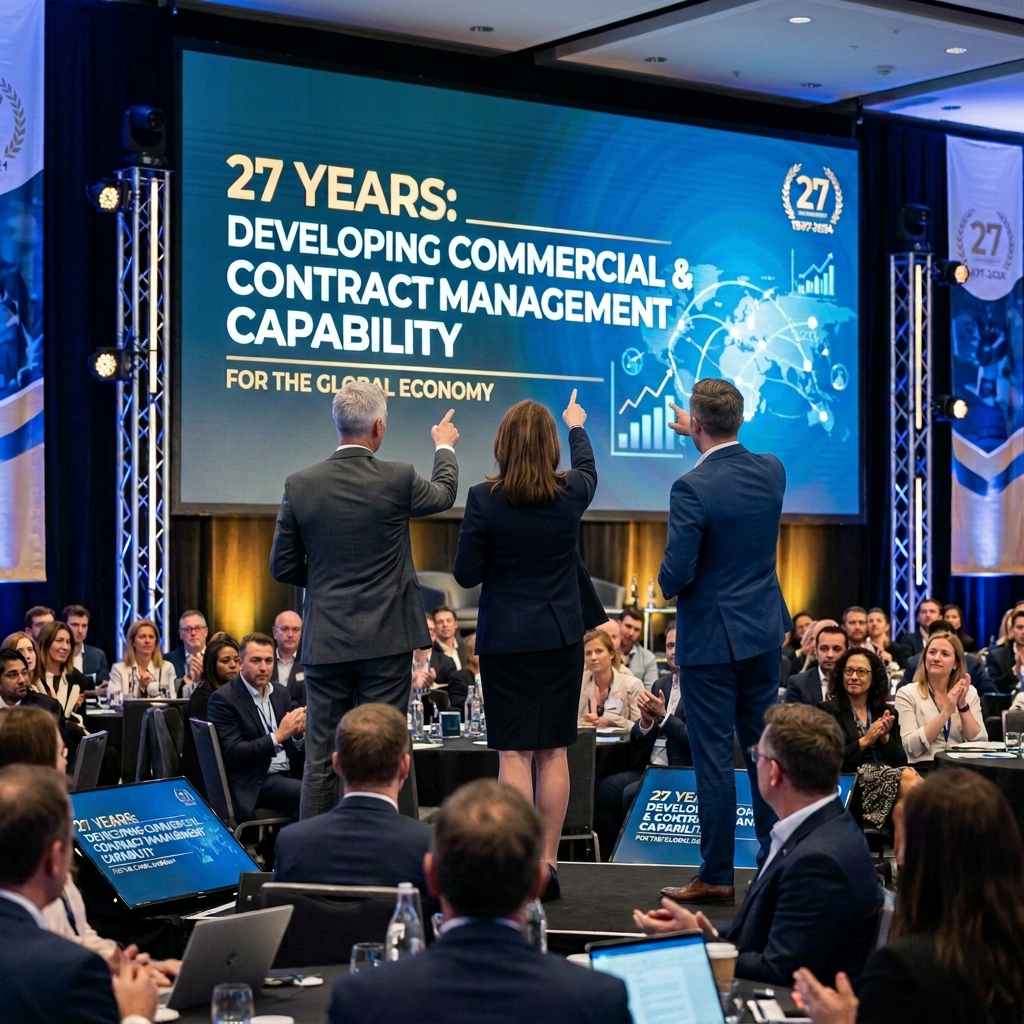
Was it worth 27 years?
Yes. Not because the job is finished, but because it never will be – and because there are now institutions and thousands of people equipped to carry it forward.


As always this article is honest and realistic and modest but what the AIs failed to identify is the supreme vision to see the need and the significant drive to make something happen (with significant others) to fulfill that need. For that, the emerging profession should be forever grateful.
Tim, you and the other hardworking and visionary people in the IACCM/WorldCC CCM community can look back on these 27 years with well-deserved pride. Your vision and persistence have helped give contract and commercial management a shared foundation and a global community.
I am grateful to play a small part in building on that foundation through classroom delivery of WorldCC’s certifications, helping practitioners turn knowledge into practical competence and sound commercial judgement.
There is much still to do, but your contribution is clear in the people now equipped to carry this work forward.
Thank you, Tim.
René