A disaster, or a well-managed asset? See how you score on this brief test:
- When the pandemic hit, was it easy to find all your contracts?
- Could you be confident it was the current version?
- Could you quickly search across each contract for key terms – for example, rights of termination or delay, force majeure, payment obligations?
- Were you able to rapidly produce consolidated management reports on risks?
- Could you easily assess the impact of supplier default on the performance of customer contracts?
- Did you have rapid insight to opportunities for renegotiation or term offsets?
Most organizations struggled with these questions – and that is the gist of an article published by law.com, in which the authors call the lack of robust contract systems ‘an unmitigated disaster’. In a poll last month, 81% of IACCM member companies acknowledged that the pandemic has accelerated the need to simplify and automate their contracting process.
Why is this still an issue?
The article in law.com calls on General Counsels to step up and fix the problem. But they can’t and they won’t. This is not a legal issue; it’s a business issue, requiring consensus across multiple stakeholders.
The pandemic has revealed the consequences of failing to treat contracts as core assets and sources of business information. The benefits that flow from developing an integrated contracting process are abundantly clear. Now is the time to push for change.
If you need data or support to assist your business case, contact info@iaccm.com.
When looking at the benefits of automation, there tends to be a strong focus on direct and measurable efficiency and economic gains. There may be mention of a notional side-benefit of ‘freeing up people to perform higher-value activities’ – though it is more likely that the CFO will have a greater focus on headcount reduction than redeployment.
Given the acknowledged importance of talent, there is a serious question to be answered over whether the nature and level of automation within a business makes a difference in attracting and retaining talented individuals. IACCM’s latest research report, to be published this week, examines this question from the perspective of contract and commercial management.
Background: The Current State
Contract and commercial management (CCM) has often struggled to gain widespread recognition of its underlying role or value within business. Yet on LinkedIn alone, there are more than sixteen million people operating with CCM job titles. Historically, the community’s status was constrained by the absence of a defined ‘body of knowledge’ and inconsistent understanding of the job role. While this is changing and has led to elevated status within many organizations, it remains a field that is often starved of investment – especially in terms of underlying systems and technology.
Research[1] shows that the typical CCM practitioner is highly qualified. 93% are educated to degree level, with 42% having advanced qualifications and 56% with a professional certification (though most in a field other than CCM). Job satisfaction levels have traditionally been high, with some 80% declaring that ‘I like my job’. But in 2019, this number had dropped to 68%, with the balance actively seeking a change. Of those, 17% wanted to continue in the role with a different employer and 15% wanted to shift to a completely different career.
This data offers us a base to explore three key questions, which are answered in the IACCM report:
- Can sources of dissatisfaction be linked to the presence or absence of automation?
- Is there any evidence to show a link between levels of automation and levels of talent attracted?
- Is there any evidence to show a link between levels of automation and levels of talent retention?
The report concludes that, while the findings cannot be viewed as definitive evidence of a direct link between levels of automation and the attraction and retention of talent, the consistency of the linkage to job satisfaction suggests that it is at least a significant factor, making people feel part of a valued team, equipped for and contributing to the future.
[1] IACCM Talent Survey, 2019
“Disbelief and denial, a sense that this is just temporary and things will soon return to the way they were, aren’t the ideal responses to change. Agility and adaptability are.”
History is littered with examples of organizations that did not adjust to change, or individuals who fought to restore their environment to the way it used to be. All these examples have something in common: they failed.
The introductory quote comes from an article in Chief Learning Officer magazine, calling on organizations to recognize the need to equip their people to understand the role they must play ‘as uncertainty and volatility become the reality of business’.
It is in this context that commercial innovation becomes critical. While the challenges we face will certainly lead to the invention of new or adapted products and services, the priority right now is to develop fresh thinking and approaches to commercial relationships and frameworks.
How will this be achieved?
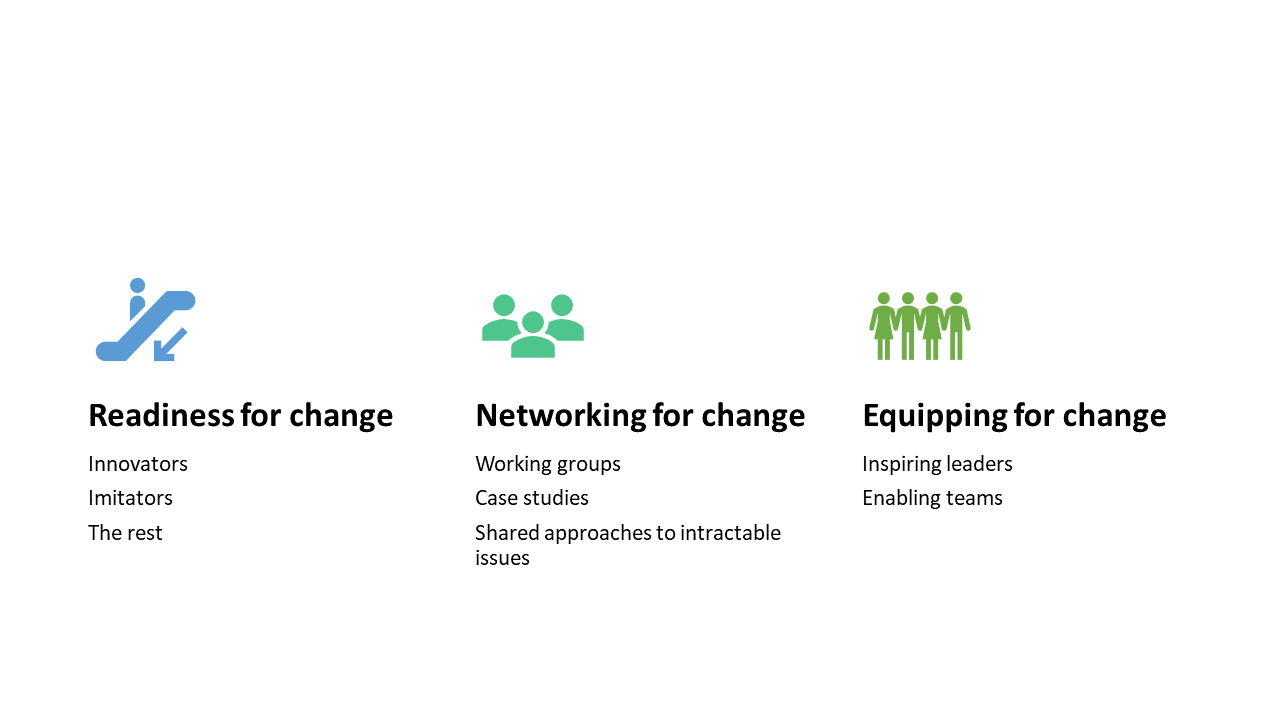
Some inspired individuals – the innovators – will certainly generate new ideas and approaches. Capturing and replicating their innovations – the imitators – is the key to widespread change. Organizations need to identify leaders and rapidly equip them with experiences that force them to adapt their thinking and understanding – for example, through immersive case studies or the challenge of solving intractable problems through working groups, such as hackathons.
But it’s not just about preparing the individual to change. It’s just as much about assessing your team’s readiness for change. And that will be challenging for many businesses, especially since environmental change has already been thrust upon them with social distancing and home working.
Tackling these issues cannot wait until things return to normal – because that return isn’t going to happen. So true leaders and smart organizations are taking steps now to equip key people to oversee the shift in commercial relationships and operations, and to understand and fill the gaps in their team’s ability to work effectively in the new environment.
Working with those individuals and organizations is at the heart of IACCM‘s current work. Equipped with up-to-the-minute research, a dynamic portfolio of learning programs and workshops, on-line assessment tools and networks, the Association has shown itself uniquely positioned to support the development of agile and adaptable commercial capabilities.
Commerce re-imagined. That truly is the ideal response to change.
Adaptive and agile. These are words that keep appearing in the context of how business (and government) must change. Adaptive and agile process. Adaptive and agile systems. Adaptive and agile workers. Adaptive and agile supply chain. The list goes on. Strangely enough, one of the few areas that has been missing is a call for adaptive and agile contracts – even though this is perhaps one of the most critical enablers of change. The rigidity of most contracts, along with serious under-investment in contracting process and capability, has become glaringly obvious throughout this pandemic.
Calls for adaptability and agility are scarcely new. The experience of coronavirus has shown that progress in embedding these capabilities and behaviors has been limited, especially in key aspects of supply relationships. The most recent IACCM report on the business impact of the pandemic draws from input by more than 2,000 commercial, legal and sourcing practitioners to identify not only the challenges, but more importantly what needs to change. The infographic below summarizes how our new commercial world must look if we truly want to build capability in managing uncertainty – to be adaptive and agile.
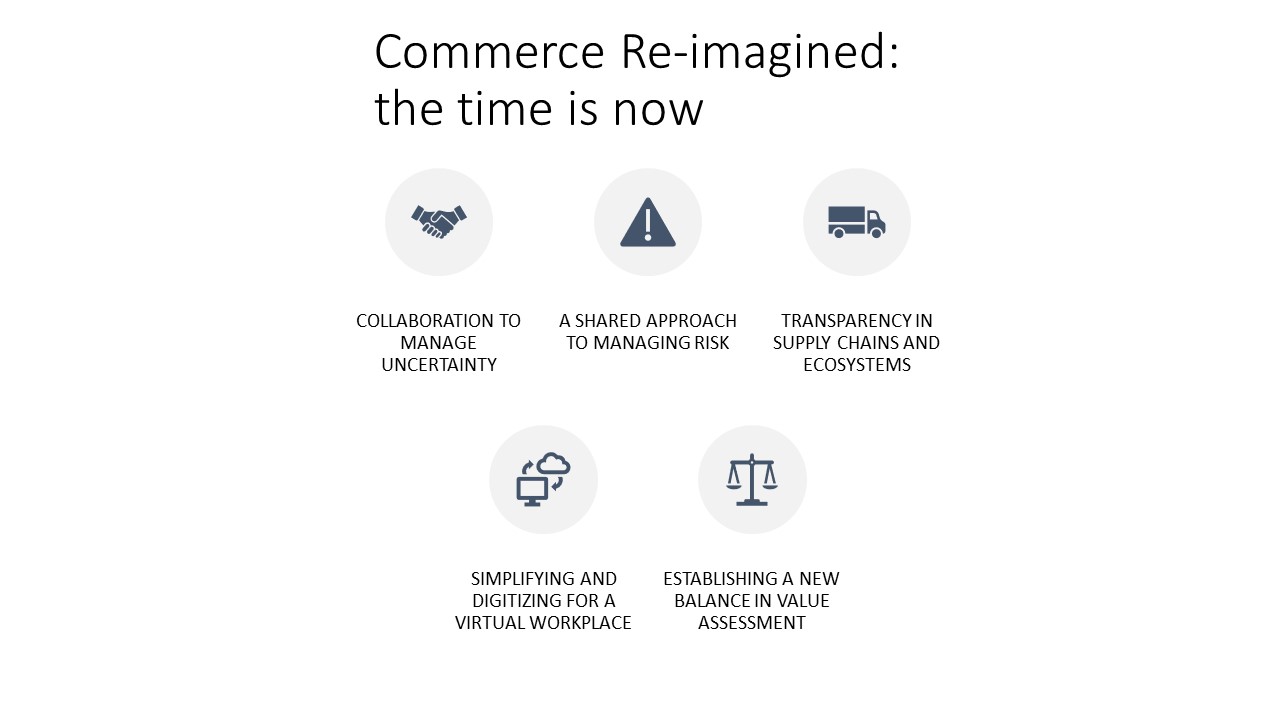
Next week, in webinars entitled ‘Emergence – Commerce & Contracting Post-COVID-19‘, IACCM will set out these findings in more detail and outline the steps being taken to truly ‘re-imagine commerce’ and make it truly adaptive and agile.
Coronavirus has created an opening for new and more expansive thinking. Will CFOs take this opportunity to introduce real change and develop more sustainable business models?
Customers will ‘more closely review their suppliers’ financial health and diversification’ as a result of thecoronavirus experience. That’s one of the findings in a PwC survey of Chief Financial Officers, conducted April 6th-8th. PwC also discovered that immediate supply chain focus has diminished in the last few weeks, though broader concerns over procurement risk management remain high on the agenda.
Future supply chains
IACCM’s research has similarly indicated that there is extensive thought being given to the question of future supply chains – their robustness, sustainability, underlying economics. Many recognize that the current model of supply chain consolidation, just in time delivery and maximized risk transfer is a thing of the past, but they are far from clear about what the future may look like.
The pandemic will inevitably result in some suppliers going out of business and others merging or being acquired. So while CFOs may decide they want to diversify their supply base, they may find there is considerably less ability to do so. Equally, they may discover that suppliers are also going to be more selective about who they want as a customer. Financial health and diversification goes two ways – and as a supplier, I would certainly be wanting to review how customers and prospects behaved during the coronavirus crisis.
Is collaboration the way forward?
As IACCM’s studies have also shown, there will be interesting reviews of current ‘make versus buy’ decisions, as well as efforts to diversify supply options. Perhaps one of the most interesting aspects of the new world will be in areas of collaboration. Clearly, one option is for businesses to ‘hunker down’ and take a narrow, inward looking, view of risk. That is unlikely to work and there are far better, more expansive alternatives. For example, we anticipate more thought about development of resilient supply ecosystems, rather than simple supply chains. The need for increased access and transparency is one thing that the pandemic has made more urgent and networks or ecosystems are far more effective at delivering these attributes. We are also observing how suppliers are looking to increased cooperation, both vertical and horizontal. The relaxation of competition controls and, in some cases, direct encouragement by governments of joint-working may be here to stay. Already, there are signs that new collaborative ventures could form to reduce the exposure to shortages and to develop affordable and efficient availability models.
Much of this thinking is not new. Many executives have been aware for some time of the need for change in how risk is viewed and managed. They have recognized that the way their more important supply relationships are structured does not yield the best results. But making a significant change risks disruption. For example, if procurement strategies shift to a focus on outcomes and life-time value, what short-term impact might that have on costs and profitability? In markets where performance is based on quarterly earnings statements, changes like this are too unpredictable, so they don’t happen. But now, there is not only a need, but also a clear opening. Over the next year, it is inevitable that financial results for most corporations will look bad relative to the past – so this is surely an opportunity for more fundamental change. Let’s hope it happens!
64% of Procurement staff, contract managers, in-house lawyers are worried about their career and job prospects in the wake of the economic destruction caused by coronavirus.
This data comes from IACCM’s series of spot surveys which have gathered input from more than 2,000 professionals across industries and world regions. None are immune – but the levels of fear vary quite dramatically. (Discover more on IACCM’s ‘Getting a Job’ webinars)
What can I do about it?
Right now, professionals in this field are mostly very busy – evaluating or renegotiating existing agreements and relationships, engaging in new or updated contracts and sources of supply. Many are also involved in more strategic evaluations of future policies, new systems or streamlined processes. But working from home, socially distanced, they feel powerless to take control, to secure their future. As one wrote:”I feel disconnected – I don’t know even how to start looking”.
Such emotions are completely understandable and, like so much else, we need to adjust our ways of thinking and working. There will be opportunities, but people will find them and be selected to fill them in different ways. In many respects, our ‘socially distanced’ world may actually make things better – for example, physical location may matter less, and reliability of internet connection becomes critical. Skills at virtual communication will be a ‘must have’ attribute, as will on-line team working.
On April 21st and 22nd, IACCM is offering a webinar, Getting a job in a time of coronavirus. We will offer insight to the industries and geographies most and least affected by job fears, plus expert advice on the practical steps you can take to best position yourself for finding new or better opportunities. Find details and register HERE.
A big item of debate right now is whether COVID-19 will cause fundamental change in the way we do business. Will it lead to a new era of collaboration? Will contracts become ‘fair and reasonable’? Or will organizations simply revert to the old ways of battling over price and risk?
Much may depend on whether the pandemic truly represents a social disruption (leading to transformation), or whether it is simply an interruption, following which things return pretty much to normal.
To give an example, in the 1300’s the Black Death eliminated around 25% of the world’s population. It led to shortages of labor, shifts in social power and geopolitics. COVID-19 is having far less impact on human life, yet short-term is having greater economic impact. Will that be enough to drive changes in our values and behavior?
A desire for change
In a poll this week, 93% of Contracts and Procurement professionals said that they hope the experiences of the pandemic will result in increased collaboration and long-term change. When asked whether they believe such change will occur, 17% say it won’t and 15% say any change will be short-term. But that left 68% who feel optimistic that this is a time when real change is possible.
That is good news – and collectively, it is something the commercial community can make happen.
The Covid-19 pandemic has powerfully indicated why supply chain visibility is an essential feature of today’s business environment. Research shows that it is also acting as a catalyst for new thinking and approaches to sourcing strategy and customer delivery models.
The latest report in the IACCM Research Forum series, titled ‘Leveraging Extended Supply Ecosystems – the role of transparency’, is therefore timely as a potential support for that new thinking. The in-depth study has been undertaken over a period of eight months and was able in its final stages to gather experience and intelligence from the pandemic, ensuring that the findings and recommendations remain pertinent to unfolding events.
The report draws an important distinction between supply chains, supply networks and supply ecosystems. All three have an important role to play within a sourcing strategy. All three require greater levels of transparency than typically exists today. Yet the drivers behind that transparency – and the selection of which supply models to use – vary considerably. They range from market-controlling to market-making in their nature and we see a number of forces promoting the ecosystem approach. These include:
- A need to deal with heightened levels of market uncertainty calling for more rapidly adaptive structures
- A need for increased collaboration to deal with shifting risk profiles and supply economics
- A need to confront a reduction in competition as suppliers consolidate or go out of business
- A need for creative approaches to develop new ecosystems as a route to innovation and to hasten business recovery
At such an unpredictable time, we see this report as very much a ‘work in progress’ – the world continues to learn and many existing relationships and supply networks are inherently unstable. A key benefit of the research is that it helps organizations distinguish their relationships based on five distinct categories of purpose and guides them in the way such relationships should then be structured, motivated and managed. It also dispels the illusion that today’s ‘supply relationships’ are exclusively the preserve of Procurement or Supply Management functions and hence the need for thought on how best to organize and integrate activities in this area.
For more information about this report, contact info@iaccm.com
The global financial crisis reduced competition by more than 20%. It is reported that the average number of bidders fell from eight before the collapse to six today. Some went out of business; others consolidated. In a few industries, this resulted in a shift of power. In others, buyers remained dominant and continued to drive down prices and margins.
The Covid-19 pandemic is arguably even more disruptive than the financial crisis. Some 90% of businesses are either issuing or receiving notices of Force Majeure. 85% are reviewing their rights of contract termination or delay. The impact on supply chains is unprecedented and has left many scurrying to better understand their current sources of supply and to identify possible alternatives. Almost 60% of businesses are re-evaluating their sourcing strategies and seeking additional or alternative suppliers. There are signs of growing collaboration between buyers and suppliers and even between competitors to maintain viable business operations.
In some cases, companies have recognized the threat to the viability of their supply chain and are providing support – for example, by early payment or renegotiated terms. But in others, the opposite is happening – delayed payment, demand for discounts, cancellation of orders even for finished products. At a strategic level, some 22% of businesses are considering bringing activities back in-house.
After years of aggressive cost-cutting, many supply chains were already fragile before the pandemic hit us. That fragility will inevitably lead to a further reduction in sources of supply. It will force many buyers to develop new approaches. Some will bring work back in-house, often through M&A activity. Others will engage in increased partnering with their suppliers. Many will seek to diversify sources of supply – but may struggle to do so.
This is a time when ethics are tested and reputations are forged. It is a time when trust and loyalty is built, or destroyed. Some businesses will survive at the expense of others. Some will survive because of others. But when it all ends, we will certainly find that many have disappeared and that the supply landscape – and the relationships within it – look very different from the way they were at the end of 2019.
As coronavirus sweeps around the world and recession looms, professionals from almost every discipline are wondering about the security of their job and income. Many are right to be concerned, but the bigger question is surely what to do about it.
Change is needed
Writing in Forbes, Mark Cohen summed up some of the critical areas where change is needed, pointing to the urgent need to eliminate organizational stovepipes and data bottlenecks: “Differentiation will become even more critical and so too will the need to collaborate with others in the supply chain. Talent platforms will accelerate this change process. There will be more collaboration across firms, corporate departments, and other providers, and the artificial divides separating them will disappear.”
Breadth and inclusion
The roles performed within a commercial and contract management process are at the foundation of these changes, yet the professionals performing those roles have in general been poorly served by universities, business schools and professional bodies. Rather than teaching breadth, they have tended towards depth; rather than encouraging collaboration, they have tended to encourage views of suspicion and skepticism to ‘outsiders’; rather than taking people on a life-long learning journey, they have tended to suggest that they offer a qualification for life.
From the time of its inception 20 years ago, IACCM promoted an alternative view. It sought to provide a curriculum and continuous development that would bring together buyer and supplier perspectives, that incorporated legal and financial thinking and a whole-world perspective – in other words, encouraging collaboration within and across supply chains, promoting cross-functional empathy and coordination. For the last 16 years, that learning and certification platform has been available on-line, making it easy, efficient and low cost to access and to maintain personal learning and qualifications, relevant to these uncertain and fast-changing times.
No need for worry?
Now, that same approach is making a break-through into the university sector, with the acknowledgment that cross-disciplinary learning is urgently needed to develop social and business capability. The University of Leeds is at the forefront, but not alone in working with IACCM to develop exciting new commercial programs.
Does this mean that individuals with an IACCM certification have no cause for concern? Of course not. But it is interesting to note that, in a recent survey, nearly 80% of those in commercial roles (procurement, legal, contract management) are somewhat or very concerned about their job and career prospects. Among those with IACCM qualifications and continuous learning, that drops to slightly less than 50%. The reason? Differentiation – the ability to add value by being part of an outward-looking collaborative community.
 Commitment Matters