In a fast-changing world, new ideas abound. Many will go nowhere. Others will be a raging success. What sets them apart?
Some ideas are simply not good. But even good ideas may not succeed and often this is because of poor commercialization – a failure to ask (and answer) the right questions or a determination to push ahead even in the face of massive obstacles.
It is commonly understood that innovation requires strong commercial back-up. Indeed, some innovations are in essence purely commercial – for example, Uber and airbnb which simply transform a supply chain through the use of technology and a new delivery system. This implies that contract and commercial managers should be playing a major role in evaluating and enabling new ideas – yet in most organizations they do not. Indeed, frequently those in commercial roles complain that they are involved too late, when their ability to shape or influence is almost non-existent.
In my role at IACCM, I am often the recipient of new ideas and as an organization, we promote innovation in contract and commercial management. I observe the reaction of our members, who tend to fall into two very distinct camps. A minority are clearly enthused by new ideas. They engage actively in discussing them and providing support, including suggestions for possible improvement or additional markets or applications. Others are more evidently thoughtful and immediately consider the idea in the context of their professional knowledge. They immediately move to practical questions such as funding, payment streams or potential liabilities and risks.
The first group – the minority – do not ignore these practical questions, but they operate in a different sequence. They see their role as assisting in the ‘ideation’, in ensuring full understanding and exploring its applicability and purpose. Only then do they move into the more fundamental questions of overall ‘commerciality’.
As I watch the faces of the innovators, it is quite clear which conversation they value – and ultimately, which advice they are more likely to accept. Those who share their excitement are immediately part of the core team; those who identify ‘challenges’ and problems are left on the edges.
These differences are important. Given the speed of change and the importance of innovation, the interesting jobs of the future will be those driving competitive differentiation and introducing – commercializing – new concepts and ideas. If you are in a commercial role, it is good to reflect on how you behave, whether you are perceived as risk-averse, obsessed by compliance and process, or whether you add value through a readiness to contribute, using your knowledge and experience to assist innovation, rather than frustrate it.
25 years ago, management guru Gary Hamel was telling CEOs about the need for self-surgery. Facing the chill winds of globalization, he explained their need to urgently reassess many of the structures and policies that had come with their former greatness. Among these were the need to rethink the management systems that had been fundamental to their success, such as operating with multiple profit centers and promising ’employment for life’. Practices like these stood in the way of lean, efficient operations and collaborative, skill-based delivery systems. They faced the choice of self-surgery or the mortician – and in the subsequent 25 years, more than half the Fortune 500 have disappeared or left the list.
Those businesses that have survived did indeed engage in self-inflicted bloodbaths. They cut non-core operations; they slashed established head count; they outsourced a myriad of functions; they automated, standardized and maximized operational efficiency. They re-thought products and services, often transitioning their core market value proposition.
As part of this process, many internal functions grew in stature and were centralized, partly to increase efficiency, partly to develop new global capability and partly to embed central controls. Legal, Procurement and Contract Management are all examples of this. And now it is time for them to engage in their own self-surgery, to enable yet another new era.
Globalization happened. It brought many changes to the way we do business. The administration of sprawling operations demanded increased controls and compliance. It created a wave of price-based opportunities, driving commoditization. It required worldwide knowledge and intelligence to take advantage of local market opportunities, cheap labor and new ideas. But now, those attributes are not enough – and many of them either get in the way or can be automated. So Legal, Procurement and Contract Management must adjust – or be adjusted!
What needs to change? High on the list are purpose, skills and technology. First of all, these groups must stop believing they are special, that they (or their business) is in some way unique. ‘Being special’ is an attribute that arises from the outside looking in, not the inside looking out. So these functions must focus on issues such as how they enable the speed, flexibility and commercial creativity needed for a digital age; how do they empower good decision-making; how do they acquire and distribute the knowledge needed for good judgment and to support differentiated products or services? The purpose of these groups must be to establish competitiveness – which means operational excellence, intimacy in relevant trading relationships and commercial innovation. The changes involve discarding old, risk averse contracting models and moving to relational structures; creating contracts designed for users, not for courtrooms; changing measurement systems to monitor outcomes; discarding redundant technology and embracing the collaborative, performance-enabling tools of today; welcoming accountability for results and ending the culture of isolation, blame or powerlessness. They need to undertake honest, objective appraisals of their existing process, skills and tools – have the courage to benchmark and to confront the steps needed to be among the best.
A new world is upon us. As someone observed last week ‘We are working in an environment where the speed of change is unprecedented. And it will never be this slow again.’
Are you ready for self-surgery?
Too many procurement groups are on a path to nowhere. They are missing the golden opportunities being created by today’s dynamic markets.
That is the conclusion I have to draw from the many conversations I have with practitioners, consultants, executive search firms and business executives. In a fast-changing world, the possibilities for growth are numerous. But in many cases, procurement professionals and their leaders are simply ignoring them because they do not fit existing paradigms, or they are too busy to pay attention to the warning signs.
For years, supply chain consultants and professional associations have been hammering on issues like compliance, category management, control – all based on the assumption that commoditization is the route to sustainable savings. This has led procurement into increasing isolation, making them masters of process, but disconnecting them from meaningful relationships with other business functions or suppliers. Indeed, many seem to glory in this isolation, feeling that it somehow confirms their objectivity and superiority as moral guardians of the business. They talk about key issues such as commercial skills and then delude themselves into thinking they are masters of these skills.
In reality, nothing could be further from the truth. Suppliers continue to see procurement as ‘the enemy’. Internal functions see them as an obstacle to good, balanced decisions. And markets are adjusting, to move beyond the pernicious effects of modern procurement practices. Suppliers have consolidated, eliminating competition in many industries. They are moving away from products towards services and solutions. They are shifting from unit prices to payment for results. These – and many other trends – are transforming the world of supply management and calling for skills that support integration, collaboration, overseeing outcomes and exercising judgment – attributes that are largely alien to the world that procurement leaders have created.
One would hope that professional leadership organizations would be assisting their members to change, providing a vision for the future. But instead, they often seem wedded to the past, calling for official status as ‘Licensed procurers’ or promoting even more draconian steps that would drive ‘savings’ or simply proclaiming the illusion that it’s only a matter of time before they ascend to the top table.
As enterprises disaggregate, needing ever more flexible and creative supply networks, this should be a golden age for those charged with selecting, forming and managing trading relationships. But as with every craft or trade of the past, relevance depends on the readiness to adapt. Right now, most procurement organizations are following a path that leads to more and more attrition as automation fulfills the roles that they perform and others step into the shoes they could be filling.
Those with vision are grasping that the future lies in the strength of relationships, in research and innovation, in creative ideas and insights – the attributes that machines find hard to replicate. It’s a world that excites IACCM and its members; its a world we must embrace, rather than retreat into the comfort of the past or find excuses to avoid.
If you are in Procurement, it’s time to rise up, to demand more, to assert your abilities and potential. The function is in desperate need of true leaders who act as drivers of change and creators of value. But to do that, you must challenge the status quo, the current mantras of control and compliance, and instead become enablers of transformation in trading relationships.
When they respond to IACCM’s talent surveys, 80% of contract and procurement professionals say they are confident that they understand the skills needed for the future. They also believe that they either have or can acquire those skills.
Are they right?
In a series of member meetings in Australia, the subject of skills has arisen on numerous occasions. There are several organizations – such as the Brooke Institute – that have undertaken significant studies in this area. All those studies suggest that skill needs are changing fast – and that the current practitioner community lacks the right profile for the challenges that lie ahead. IACCM benchmarking and skills assessments suggest they are right.
The nature of contracts and trading relationships is changing fast. We are moving to an increasingly complex environment where many projects and contracts are impacted by high levels of uncertainty or ambiguity. A growing number are performance or outcome based.
Complexity changes the sort of competency needed, from following process, ensuring compliance, obeying rules to instead making judgments. This means a need to be aware of the process and the rules and to understand how to work around or within them in ways that do not threaten success. It also demands a set of leadership skills and a readiness to engage with the outside world, to understand market trends and practices.
The problem we face is that the standard skills of following process, obeying rules and ensuring compliance will rapidly be automated. Right now, there is limited evidence that the practitioner community is acquiring the competencies needed for the future. But this is an area on which IACCM is working and will steadily introduce new approaches to training and skills development.
Over-hyped, inward-looking, of no practical use or value. That’s the conclusion any rational leader would reach in an objective analysis of the sprawling risk-management industry.
Recognizing and grasping opportunity lies at the heart of human and social development. Everything that can go right can also go wrong. Achieving balance is the core of commercial management and resides in attitudes, intelligence, adaptive design – not the mumbo-jumbo of self-serving specialists.
Life is not measured by slide rules. It is often unpredictable and we weather much of that unpredictability through exercising judgment. As a discipline, risk management tries to take us back to the days when medicine was performed by ‘balancing of the humors’. It served no practical purpose and often left the patient far worse off than they were before they exposed themselves to ‘the experts’.
Traditional sources of business value are under sustained attack, with current models often protected only by a flimsy regulatory environment.
As supply chains transform, commercial power and influence is shifting dramatically within industries, between industries and in many cases to start-ups with virtually no assets. Within 5 years, who will control your markets?
Consider for a moment how the early emergence of online retailers has led to mass aggregators of ecommerce such as Amazon, Alibaba and eBay. Companies such as Uber and airbnb are disrupting traditional value networks for transportation and hospitality. It is widely expected that power in markets for energy and water will steadily switch from utilities to service aggregators. And even in a highly profitable field such as pharmaceuticals, digital technologies will drive fundamental change in drug delivery.
The combination of networked technology and digitalization will continue to generate enormous change in product and service design and delivery. In long-established industries such as oil and gas and pharmaceuticals, top executives have already grasped that their key partners for the future are not those within their industry, but outside. They are forming new alliances and partnerships. They are shifting their attitudes on fundamental issues such as IP ownership or the use of power.
A common theme in all of this is that success increasingly depends on an organization’s ability to structure and manage complex (and shifting) networks of relationships. It is commercial acumen that lies at the heart of today’s winning business – and devising and executing the right forms of contract to define and hold those networks together.
Even as senior executives are embracing the importance of contract management competence, they are at the same time questioning the value of their contract management resources.
These positions are not incompatible. They simply reflect a sense on the part of many executives that the function should be doing more, that it should be more visible, that it should be able to describe and illustrate its value to the business. So the agenda is not to eliminate contract management; quite the opposite, it is to demand evidence from incumbent groups that they understand their role and are delivering against it.
Unfortunately, many contracts and commercial groups struggle with such a demand. They are busy; they do a lot of things. But they rarely measure their effectiveness in a way that would be meaningful to the executive agenda.
I receive many request from IACCM members who face questions of this type. In one recent case, I replied as follows:
Your exercise should begin with an analysis of corporate goals. What is it that your executives value? Clearly revenue and margin will be high on their list, but there are probably other key factors which contribute to that financial success. They may include things like speed of execution; corporate reputation (honesty, integrity, reliability); innovation. If you want to demonstrate value, you must link functional contribution to some or all of those goals.
You might look at some of the recent benchmark data we have produced and start to evaluate whether this is true in your organization. For example:
– Organizations with a consolidated contracts function operate more efficiently than those with either fragmented or no dedicated CM resource. Obviously, contracts have to be managed by someone. The data shows that FTE heads are reduced by 35% when there is a consolidated function. VALUE: contribution to margin through reduced costs.
– A CM function reduces value erosion on contracts. It is typical for many agreements to either under-deliver on expected revenues or to overshoot on planned costs. Data suggests that an effective CM function reduces value erosion by 5 – 8%. This does not include its impact on contract or revenue growth – for example, through negotiated changes – but it does include disciplined change management and handling of claims and disputes. VALUE: contribution to revenue and margin through retained revenue and cost containment.
– The use of CM resources cuts cycle times and reduces the frequency of claims and disputes. Early engagement of CM in the bid phase of an opportunity typically reduces time to signature by 15% and reduces post-award claims and disputes by 24%, primarily through greater clarity of scope and goals, ensuring appropriate form of agreement and related terms and conditions. VALUE: increased speed to contract closure and revenue. Improved customer satisfaction and avoidance of reputation risk.
– In some organizations, CM is an active contributor to innovation. This depends on its leadership and objectives. The CM process generates extensive data, much of which indicates issues such as frequency of negotiated terms, frequency of claims, internal inefficiencies, accuracy of billing etc. Those insights can turn the CM function into a quality management function, generating ideas and initiatives for continuous improvement (e.g. revisions to standard terms, new commercial policy or practices, process simplification). VALUE: reduced costs, improved reputation, innovation in commercial terms or capabilities.
– Organizations with dedicated contract managers record higher levels of customer satisfaction and are more likely to earn repeat business. The data here is a little complicated and the results depend in part on the proficiency of CM and its measurements. It is, for example, important that CM is not a largely administrative activity and that its motivations are not to ‘nickel and dime’ the customer on every issue that arises. In those organizations where the function is measured on delivering successful contract outcomes, average NSI is some 6 points higher.
Moving forward, we see indications that an increasing number of customers will start to explore supplier competence and reliability as part of their sustainability evaluation. There is growing awareness that competence in contract management is a strong indicator of reliability and ethical standards. As a reference document, you might read (and reference) the National Audit Office report on contract management of September 4th 2014.
Unfortunately, I cannot fix the problem that most contract management groups collect little or no performance data. All I can do is give those who are IACCM members some insights to the sort of results that their work may be delivering – and hope that they can use this to buy time and to show top management that they are at least ready to start the journey to value delivery. If they are not ready, the job will increasingly be passed to others.
Anyone handling contracts on a regular basis understands that managing stakeholders is one of the biggest challenges. Contracts touch and affect many people within and outside an organization, but in quite different ways. Some view themselves as owners, others as users and still more as reviewers or approvers. And then there are those who may simply be affected in some way by the aims or purpose of the contract.
When you face such a broad array of people or functional interests, a well-defined and managed workflow is essential. Without it, risks are increased and quality and efficiency decline.
The problem facing many organizations is that the volume of stakeholders continues to increase. Factors such as growing professional specialism, increasing regulation and greater concern over reputational risk mean that cycle times are lengthening and internal productivity levels are under threat. In a competitive global market, these are not acceptable developments – so the choice becomes either to cut corners and take risks, or to define workflow and introduce effective management systems.
Workflow was the subject of a webinar that IACCM undertook recently with software provider Selectica. In the program, we reviewed some of the benchmark data that reveals a growing divide between the best and worst industry performers. For example, cycle times for contract negotiation vary by more than 300%. The volume of contracts handled by an individual contract manager shows an even wider difference. The overall resources administering contracts are also affected – and the best performers are freeing resources to undertake added-value and differentiating activities such as competitive research and data analytics.
In many ways ‘workflow’ is just another word for ‘process’ – or is at least a by-product of it. The problem for many organizations is that they still have not adequately defined their contracting process. It remains a set of unconnected activities, lacking clear ownership or accountability. This means that value is lost and risk increases – but these weaknesses are missed because, without a monitored process and supporting systems, the problems and their consequences remain invisible.
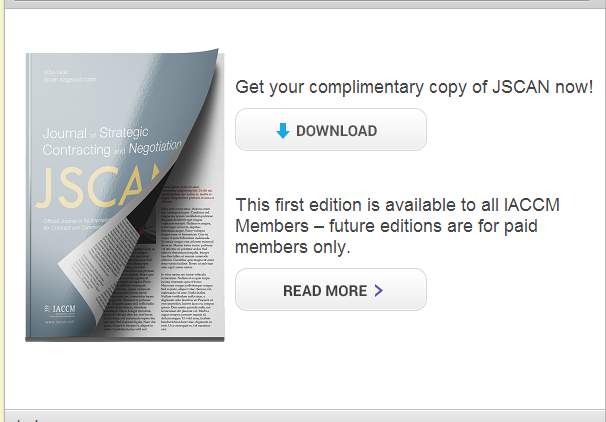 The launch of the Journal of Strategic Contracting & Negotiation is a momentous event for anyone who cares about the field of contracting. For the first time, there is a dedicated academic journal that will promote and consolidate research in this area.
Since its launch in 1999, IACCM has been able to point to a series of important milestones. Among these, the introduction of a core ‘body of knowledge’ and the success of professional certification are two obvious examples. Without these, there can never be ‘a profession’ – instead, those performing contracts or commercial roles would remain isolated groups or individuals with no evident career path or status.
The Academic Journal takes us to a new level because it reflects a belief in academia that our field is important and that it merits dedicated research. It offers a realistic hope of wider availability of degree-level programs, adding to the handful that already exist.
Such a development also raises the profile and respectability of our work, since it means through research we can demonstrate the impact of contracting on business outcomes.
The first edition of JSCAN is available now, at no charge. Future editions will be free to IACCM members – yielding a large global circulation from inception.
To access your copy, simply visit www.iaccm.com and click the icon above
In the past, companies often put contract management resources within the Sales organization. It was seen as an administrative support function.
When it came to Procurement contracts, they rarely had any dedicated resources. Responsibility for overseeing contract performance was often undefined.
Over time, many organizations started to realize that contracts were too important to be left in Sales. They grasped the point that there are too many conflicts of interest. A Sales function – or business unit – is typically driven by narrow financial measurements of revenue and profit, with perhaps elements of customer satisfaction. Contracts are certainly fundamental instruments in winning business and delivering revenue, but they are far more than that. They contain enforceable commitments that can jeopardize an organization’s future and on which its long-term health and reputation depend. Therefore contract negotiation and management cannot be left to the discretion of a function that is directly motivated to maximize short-term financial goals.
Today, except in some relatively small businesses, it is rare to find contract management groups reporting to the Sales organization.
So what about Procurement contracts? What is the problem there? It is actually that Procurement is in many ways the counter-side of Sales. In most cases, it is driven by narrow financial measurements that stand in the way of broader business judgment. Indeed, many Procurement groups see contracts as having limited relevance to business performance. They do not grasp – or are not motivated to grasp – the wider significance of terms and conditions on business risk, achieving value, driving innovation.
High-performing corporations create a close alignment between Sales and Contract Management, but ensure their separation. IACCM’s most recent benchmarking data appears to suggest that the best performers ensure similar separation between Procurement and Contract Management.
 Commitment Matters